Taking the train is like travelling, only better!

    Find out how, behind every TGV journey, we are working towards more sustainable mobility: more low-carbon, more resilient, more sober, more circular, more human... in a word, BETTER!
    Updated on 10 November 20257-minute read

    Is taking the train really more environmentally friendly? 95 times yes!

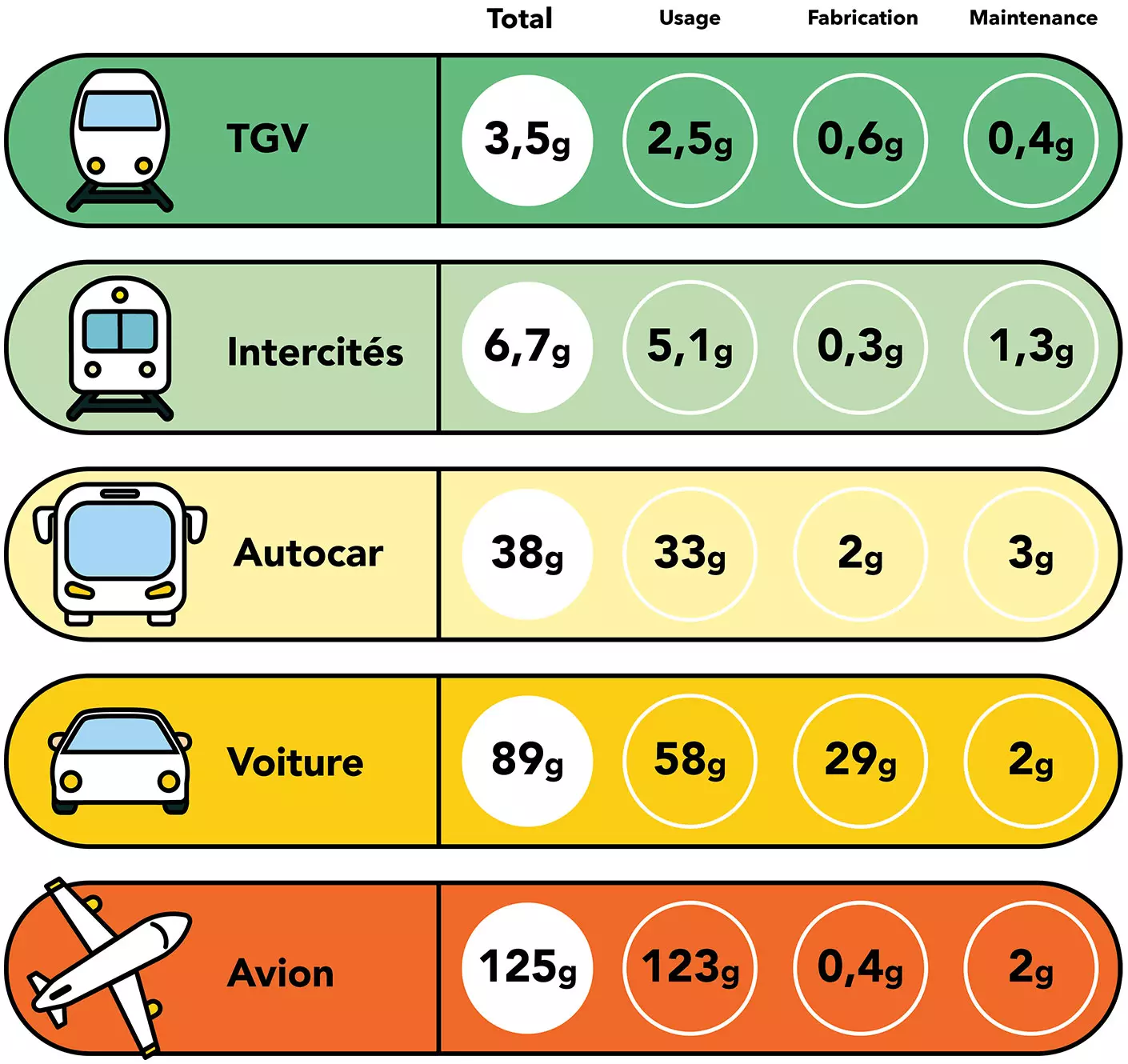
    Taking the train in France means on average 95% fewer greenhouse gas emissions1 than travelling by car2 or plane, which is why we are encouraging people to make the most of it, in order to effectively reduce France's carbon emissions. And how do we know all this? We compared theCO2 emissions of each mode of transport using this methodology

    To find out how: click here!
    Comparateur carbone longue distance (gCO2e/voyageur/kilomètre)

    Table showing the greenhouse gas emissions of a passenger travelling one kilometre in France, taking into account the impact of the use, manufacture and maintenance of the vehicle (gCO2e/Passenger/Kilometre).

    Comparison of data, in ascending order:

    • TGV (3.5 grams of CO2e in total, including 2.5 grams of CO2e for use; 0.6 grams of CO2e for manufacture; 0.4 grams of CO2e for maintenance)
    • Intercités (6.7 grams of CO2e in total, including 5.1 grams of CO2e for use; 0.3 grams of CO2e for manufacturing; 1.3 grams of CO2e for maintenance)
    • Coach (38 grams of CO2e in total, including 33 grams of CO2e for use; 2 grams of CO2e for manufacture; 3 grams of CO2e for maintenance)
    • Car (89 grams of CO2e in total, including 58 grams of CO2e for use; 29 grams of CO2e for manufacture; 2 grams of CO2e for maintenance)
    • Plane (125 grams of CO2e in total, including 123 grams of CO2e for use; 0.4 grams of CO2e for manufacturing; 2 grams of CO2e for maintenance).

    For the car mode, the data is based on a mix of electric and combustion-powered cars. The occupancy rate of 2.2 passengers is applied, corresponding to long-distance travel.

    For SNCF Voyageurs modes of transport, 2024 values for use, manufacture and maintenance (maintenance-related emissions only include energy consumption used to maintain our trains).

    For other modes, ADEME's Base Empreinte values for use and manufacturing and Carbone 4 study values for SNCF for maintenance.

    x2
    the modal share of rail by 2040: we'll get there together!
    New in history: climatic hazards

    Storms, heatwaves and floods: these hazards are intensifying as a result of climate change and disrupting our business. So we need to anticipate them today if we are to continue to ensure continuity of service tomorrow. This is Adaptation to Climate Change, a key issue for us, for you, and for our employees!

    Find out why and how

    And while you're driving: we're reducing our impact

    Are you familiar with the principle of eco-driving... for trains? Did you know that our trains are 92% recyclable (soon to be 97%!)? Or that we spend 2 million hours every year identifying parts that can be repaired and reused? As you can see, we are taking action on all fronts #Carbon #Energy #Circular Economy #Water #Biodiversity...

    We tell you all about it here

    -30% and 50% reduction in GHG emissions from traction and our buildings by 2030

    Our commitments to a more humane and caring society

    All over France, our employees are proud to be involved with us in their jobs, but also in community and environmental initiatives. We actively support and promote this commitment, taking particular care to ensure that working conditions are as comfortable as they are fulfilling.

    We tell you all about it here

    Discover our 4 CSR commitments

    for mobility that is as positive as it is low-carbon.

    1/ Methodology and details available on : https://www.sncf-voyageurs.com/fr/comparateur-carbone/ - Source: Base Empreinte ADEME 2024(https://base-empreinte.ademe.fr/) and Carbone 4 comparative analysis. Greenhouse gas (GHG) emissions expressed in CO2 equivalent (CO2e) for long-distance trains are calculated in accordance with the methodological guide to GHG information for transport services published by the French government and certified by the Statutory Auditors. These values correspond to an average expressed in passenger-kilometres and include the entire life cycle (use, manufacture and maintenance of the equipment). The comparison is made between a journey by long-distance train in France, by short-haul plane, by long-distance coach and by car, based on a mix representative of the French fleet (internal combustion cars and electric cars) with an average occupancy rate (of 2.2 passengers for long-distance journeys in France, in accordance with ADEME data).

    2/ containing 2.2 passengers, occupancy rate for long-distance car journeys in France established by ADEME

    Discover also

    With TGV INOUI

    Read more

    With INTERCITÉS

    Read more

    Our green mobility solutions

    Read more

    Header : © SNCF Voyageurs

    Infographic : © SNCF Voyageurs

    New in history: climatic hazards : © SNCF Voyageurs

    Our commitments to a more humane and caring society : © SNCF Voyageurs

    Discover also : © Com à l'écran / Alex Profit / Sébastien Godefroy