Our ambition: to make you prefer the train

    Today, we are witnessing a new golden age for rail, driven in particular by the urgent need to tackle climate change. As the mode of transport that emits the least carbon, we have a responsibility to take our full place in a low-carbon society by making trains the backbone of mobility.

    Our objectives for 2030

    • Reduce greenhouse gas emissions generated by traction by 30% and by 50% those generated by real estate (versus 2015)
    • Recover 100% of reusable waste and reinforce circular economy principles
    • Reduce water consumption by 20% (vs 2022)
    • Thanks to the train, avoid 20 million T ofCO2ein the transport carbon footprint
    • 100% of employees trained in CSR concepts

    The train is the most responsible mode of transport. It's up to us to make this strength a reflex for everyone.
    Christophe Fanichet, Chairman and CEO of SNCF Voyageurs

    Transport carbon comparator

    Taking the train in France means reducing by 90% on average theCO2eemitted for an equivalent journey by road or air*.

    * comparison on complete perimeters. Average figure. Air travel is only compared with the TGV.

    Download the pdf version of the CO2 transport comparator

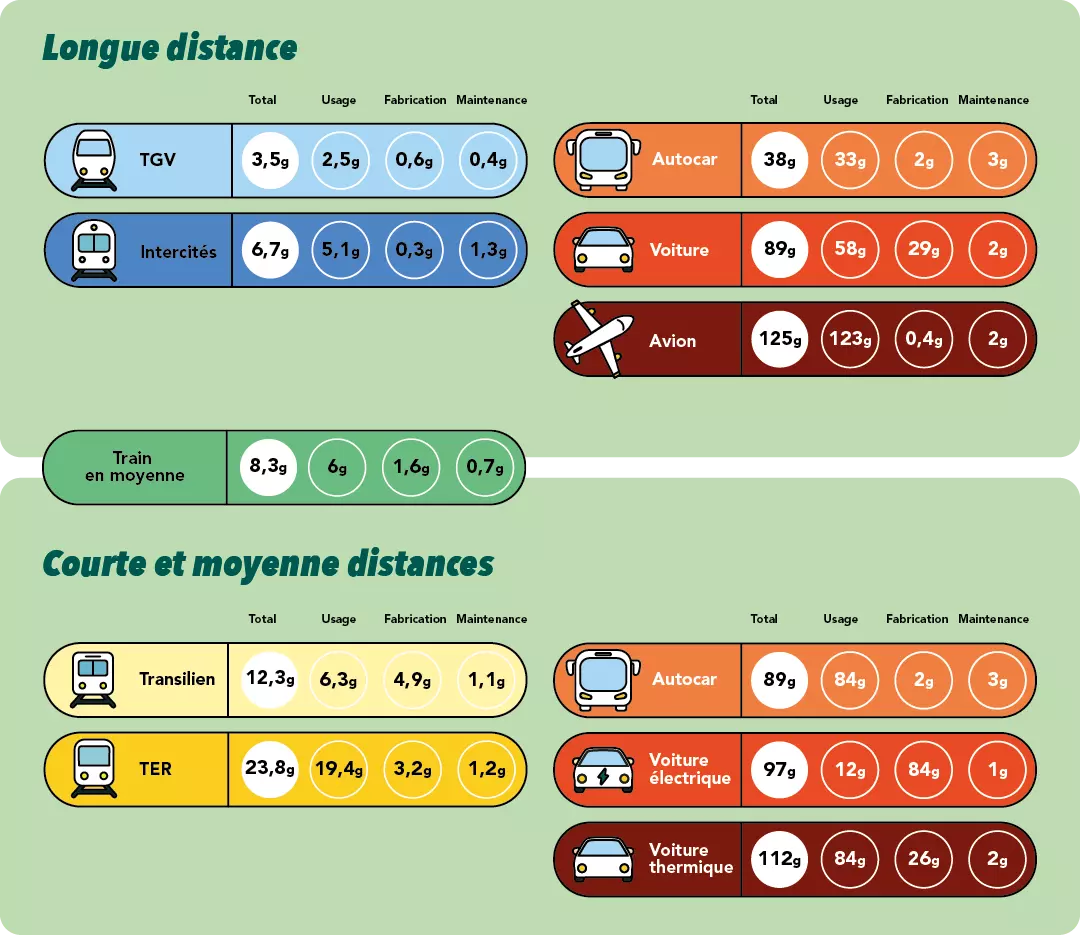
    Table showing greenhouse gas emissions for a passenger traveling one kilometer in France, taking into account the impact of vehicle use, manufacture and maintenance (gCO2e/Passenger/Kilometer).

    Comparison of long-distance data, in ascending order:

    • TGV (3.5 grams of CO2e in total, including 2.5 grams of CO2e for use; 0.6 grams of CO2e for manufacture; 0.4 grams of CO2e for maintenance)
    • Intercités (6.7 grams of CO2e in total, including 5.1 grams of CO2e for use; 0.3 grams of CO2e for manufacturing; 1.3 grams of CO2e for maintenance)
    • Coach (38 grams of CO2e in total, including 33 grams of CO2e for use; 2 grams of CO2e for manufacture; 3 grams of CO2e for maintenance)
    • Car (89 grams of CO2e in total, including 58 grams of CO2e for use; 29 grams of CO2e for manufacturing; 2 grams of CO2e for maintenance)
    • Airplane (125 grams of CO2e in total, including 123 grams of CO2e for use; 0.4 grams of CO2e for manufacturing; 2 grams of CO2e for maintenance).

    • Train (8.3 grams of CO2e in total, including 6 grams of CO2e for use; 1.6 grams of CO2e for manufacturing; 0.7 grams of CO2e for maintenance).

    Comparison of short- and medium-distance data, in ascending order:

    • Transilien (12.3 grams of CO2e in total, including 6.3 grams of CO2e for use; 4.9 grams of CO2e for manufacturing; 1.1 grams of CO2e for maintenance)
    • TER (23.8 grams of CO2e in total, including 19.4 grams of CO2e for use; 3.2 grams of CO2e for manufacturing; 1.2 grams of CO2e for maintenance)
    • Coach (89 grams of CO2e in total, including 84 grams of CO2e for use; 2 grams of CO2e for manufacture; 3 grams of CO2e for maintenance).
    • Electric car (97 grams of CO2e in total, including 12 grams of CO2e for use; 84 grams of CO2e for manufacturing; 1 gram of CO2e for maintenance).
    • Internal combustion car (112 grams of CO2e in total, including 84 grams of CO2e for use; 26 grams of CO2e for manufacturing; 2 grams of CO2e for maintenance)

    For the long-distance segment, for the car mode, the data is based on a mix of electric and combustion-powered cars. An occupancy rate of 2.2 passengers is applied, corresponding to long-distance travel.

    On the short and medium-haul segment, for car modes, an occupancy rate of 1.6 passengers is applied, corresponding to medium-haul.

    The coach figure is calculated from an average of the three coach types (long-distance, intercity and Île-de-France), weighted by the actual distances covered.

    For SNCF Voyageurs transport modes, 2024 values for use, manufacture and maintenance (maintenance-related emissions only include energy consumption used to maintain our trains).

    For other modes, ADEME Base Empreinte values for use and manufacturing, and Carbone 4 study values for SNCF for maintenance.

    Discover also

    Travel with us

    Read more

    SNCF Voyageurs

    Read more

    Our divisions and subsidiaries

    Read more

    Header : © Alex Profit

    News : © SNCF Voyageurs / ©SNCF Voyageurs / Maxime Huriez / ©Shutterstock / Com à l'écran

    Infographic : © SNCF Voyageurs

    Discover also : © Christophe Recoura / Sébastien Godefroy / Christophe Recoura